door bhrw | jan 16, 2026 | B12, UK Biobank, wetenschap

Scientists have identified the first DNA variant associated with a higher risk of developing B12 deficiency when a person is treated with metformin.
The analysis, which was done by the authors, identified a genome-wide non-synonymous SNP in the cubilin gene (CUBN, rs1801222/p.S253F), which was significantly associated with metformin-induced vitamin B12 deficiency. This finding was replicated in three Scottish cohorts, in the Diabetes Prevention Program Outcomes Study (DPPOS) cohort, and in a small clinical cohort from Liverpool. Vitamin B12 deficiency occurred in 0.84–1.20% of individuals who were not exposed to metformin regardless of their rs1801222 genotype. However, a large interaction with metformin use was observed, with vitamin B12 deficiency developing at 6.02% in GG, 7.96% in GA and 12.84% in AA genotype groups.
Co-author Ewan Pearson: “The 14% of white population with AA genotype are 2.5 times more likely to require B12 replacement GG. Equates to 10% requiring B12 replacement by 11 years after starting metformin with AA genotype vs 21 years for GG. A large effect!”
It should be noted that the primary analysis was conducted among participants in the UK Biobank. Individuals were identified with a diagnosis of vitamin B12 deficiency and/or a record of B12 injection prescriptions, and metformin use was extensively documented. However, clinical diagnosis of B12 deficiency is often only done on the basis of abnormal B12 measurements, and -for instance- measurements of methylmalonic acid are rarely done. Furthermore, people who are using (multi)vitamin supplementation may not so easily be recognized as truly B12-deficient. So, the incidence of B12 deficiency may be higher than reported in the paper. Nevertheless, this is great work in the beautiful dataset of UK Biobank, and confirmed in other cohorts, such as Generation Scotland, GoDARTS, and SHARE, and DPPOS. Researchers are eagerly awaiting the time when UK Biobank data will also be enriched with serum B12, MMA, and homocysteine measurements for all participants.
Full source: https://link.springer.com/article/10.1007/s00125-025-06655-5
For translation into Dutch, copy this blog to Google Translate
door bhrw | okt 17, 2025 | diabetes, wetenschap
The title of this blog contains two abbreviations, but important ones. IAH is impaired awareness of hypoglycaemia, and AGRP (or AgRP) is agouti-related protein. They are central in a paper just published by my talented colleague, Dr. Rita Varkevisser.
Learn how she summarizes the importance of this paper:
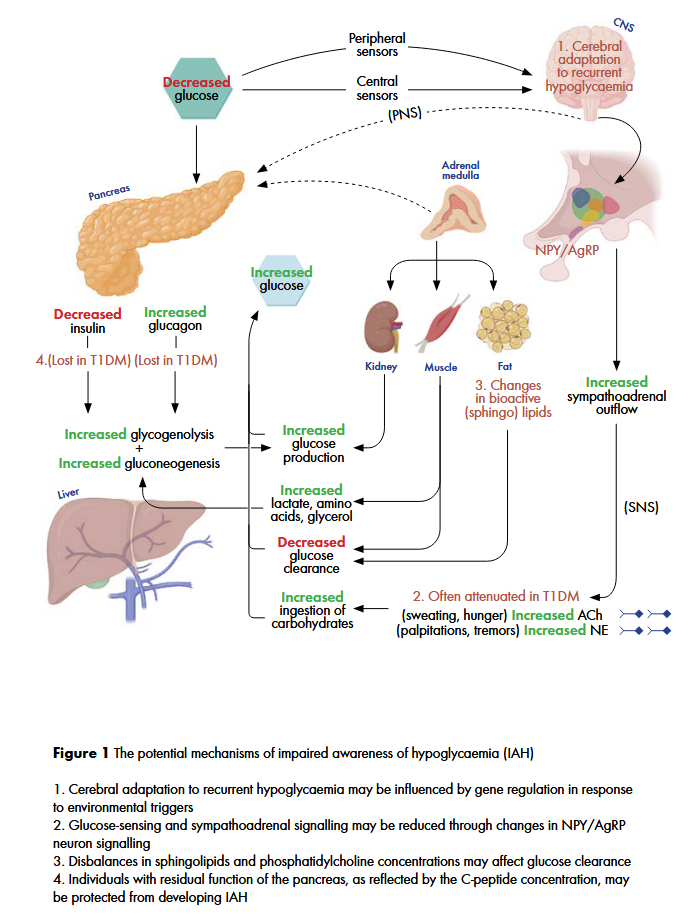
A compelling finding of this study was the association between agouti-related protein (AgRP) and impaired awareness of hypoglycaemia. AgRP is an important neuropeptide in energy homeostasis and is expressed in the adrenal gland and hypothalamus, specifically in the arcuate nucleus (ARC) and ventral hypothalamic nucleus (VMH) where central glucose sensing occurs. These glucose-sensing neurons in the ARC can influence glucose homeostasis through the activation of the autonomic nervous system and exert orexigenic effects through release of AgRP which inhibits MC4R neurons that stimulates food intake. The lower circulating plasma AgRP in individuals with IAH could suggest that these individuals could be less responsive to lower glucose levels. This may be due to threshold changes in the glucose-sensing neurons in the ARC and less hypothalamic-pituitary-adrenal (HPA) activation leading to less AgRP release from neuroendocrine cells in the adrenal medulla.
Another mechanism that may reduce AgRP release is the inhibition by other hormones such as insulin and leptin. Higher circulating levels of insulin usually leads to a reduction in appetite. In some individuals, hypothalamic insulin resistance may lead to increased food consumption despite higher circulating insulin levels. As a consequence of this insulin resistance, these individuals may be protected from hypoglycaemia, as the appetite suppression that would normally occur is no longer present. Although it is not yet clear how recurrent hypoglycaemia can influence glucose sensing and ARC/VMH mediated counterregulatory responses, further research into AgRP may help to elucidate the pathophysiology of IAH.
The mechanisms which dr. Varkevisser summarizers to play a role in IAH, are shown in this figure:
Dr. Varkevisser successfully defended her scientific thesis in November 2024. The full thesis with all her articles can be found on the University of Groningen website: https://research.rug.nl/en/publications/a-balancing-act-navigating-cardiovascular-vigilance-and-hypoglyca
door bhrw | mrt 10, 2025 | diabetes, Lifelines, schildklier, stofwisselingsziekten, wetenschap
Iedere twee jaar wordt ter ere van Ernst Laqueur, die wordt beschouwd als een van de grondleggers van de moderne endocrinologie, een lezing gehouden door een onderzoek(st)er die in de afgelopen decennia veel voor de (neuro)endocrinologie heeft betekent. Het bestuur van de NVE selecteert de Laqueur lecturer.

(meer…)
door bhrw | mrt 2, 2025 | B12, wetenschap

In this exciting new study, the authors (several of them being CluB-12 members) enrolled 231 healthy elderly volunteers (median age 71.2 years old) with a median B12 blood concentration of 414.8 pmol/L (as measured by automated chemiluminescence assay). They performed a variety of evaluations, including multifocal visual evoked potential testing, processing speed testing, and magnetic resonance imaging to assess neurological status. They also measured serum biomarkers of neuroaxonal injury, astrocyte involvement, and amyloid pathology.
Their main findings were:
Low B12, especially decreased holo-transcobalamin (sometimes called ‘active B12’, as this is the form of B12 that can be taken up into the brain), was associated with visual evoked potential latency delay, processing speed impairment (in an age-dependent manner), and larger volumes of white matter hyperintensities on MRI. High levels of holo-haptocorrin (the biologically inactive fraction of B12) correlated with serum levels of Tau, a biomarker of neurodegeneration.
In a press release, the authors wrote: “The current threshold to consider B12 deficiency as a diagnosis and to supplement with vitamin B12, is currently set at 148 pmol/L and is successful at treating most cases of B12-related anaemia. However, a significant amount of people with B12 levels above that threshold have complained of neurological symptoms which improved when getting B12 supplementation. We show that in an older population, lower B12 levels (but above the current threshold of 148 pmol/L) are associated with impaired myelination (slower mfVEPs), neurological function (slower processing speed) and structure (higher WMH lesions on MRI). However, serum biomarkers for neurodegeneration (Tau and UCHL-1) were elevated in people with higher inactive B12 levels.” Remember, dear readers, inactive B12 can not be taken up into the brain. It may be a mere marker, and not a cause of higher Tau levels.
The authors have drawn a number of important conclusions:
• The current threshold that defines B12 deficiency must be revisited.
• Clinicians should consider B12 supplementation in older patients with neurological complaints even if B12 levels are higher than 148 pmol/L. But, how do we select these individual;s, and what follow-up do we provide for them?
• Both low active B12 levels and high inactive B12 levels should be considered in future studies about the impact of B12 on neurological function;
• We must invest in more research about the underlying biology of B12 insufficiency since it may impact brain ageing and can be a preventable cause of cognitive decline.
Research grant providers should prioritize research in the aforementioned areas.
Link to the article: https://onlinelibrary.wiley.com/doi/10.1002/ana.27200
door bhrw | nov 3, 2024 | gezondheidszorg, Lifelines, wetenschap

Er zijn verschillende manieren om het risico op het ontstaan van hart- en vaatziekten beter in te schatten. Eén ervan is het meten van de huid autofluorescentie (skin autofluorescence, SAF) met behulp van de zgn. AGE-reader, een andere is het doen van een CT-scan van de kransvaten van het hart en het meten van de verkalkingen hierin, de ‘coronary artery calcium score’ (CACS). In een unieke samenwerking met de collega’s van de afdelingen Radiologie, Epidemiologie en Cardiologie hebben wij beide methoden met elkaar vergeleken bij mensen die deelnamen aan de Lifelines Cohort studie.
(meer…)
door bhrw | nov 2, 2024 | gezondheidszorg, UK Biobank, wetenschap

Background & aims: Noninvasive tools (NITs) are currently used to stratify the risk of having or developing hepatic steatosis or fibrosis. Their performance and a proteomic-enabled improvement in forecasting long-term cardio-renal-metabolic morbidity, malignancies, as well as cause-specific and all-cause mortality, are lacking. Therefore, the performance of established NITs needs to be investigated in identifying cardio-renal-metabolic morbidity, malignancies, cause-specific and overall mortality and improve their performance with novel, proteomic-enabled NITs, including growth differentiation factor 15 (GDF-15), allowing multipurpose utilization.
Methods: 502,359 UK Biobank participants free of the study outcomes at baseline with a 14-year median follow-up were grouped into three categories: a) general population, b) potentially metabolic dysfunction-associated steatotic liver disease (MASLD) population, c) individuals with type 2 diabetes mellitus. The investigated NITs include Aspartate aminotransferase to Platelet Ratio Index (APRI), Fibrosis 4 Index (FIB-4), Fatty Liver Index (FLI), Hepatic Steatosis Index (HSI), Lipid Accumulation Product (LAP), and metabolic dysfunction-associated fibrosis (MAF-5) score.
Results: Adding GDF-15 to the existing NITs led to significantly increased prognostic performance compared to the traditional NITs in almost all instances, reaching substantially high C-indices, ranging between 0.601 and 0.808, with an overall >0.2 improvement in C-index. Overall, with the GDF-15 enhanced NITs, up to more than seven times fewer individuals need to be screened to identify more incident cases of adverse outcomes compared to the traditional NITs. The cumulative incidence of all outcomes, based on the continuous value percentiles of NITs, is increasing exponentially in the upper quintile of the GDF-15 enhanced NITs.
Conclusions: The herein-developed GDF-15 enhanced indices demonstrate higher screening effectiveness and significantly improved prognostic abilities, which are reduced to practice through an easy-to-use web-based calculator tool (https://clinicalpredictor.shinyapps.io/multimorbidity-mortality-risk/).
Het resultaat van een mooie samenwerking tussen UMCG (Klinische Farmacie & Farmacologie, en Endocrinologie), Ancora Health, en Harvard Medical School.
Download het volledige artikel hier: https://www.metabolismjournal.com/article/S0026-0495(24)00275-0/fulltext





Recente reacties